
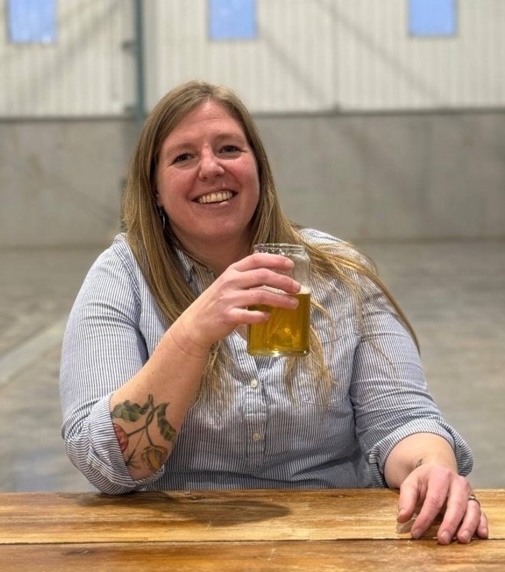
This profile first appeared in Yankee Brew News.
Tell us about how you got into the hop-selling industry.
I’m based out of southern New Hampshire and am the northeast account manager for Crosby Hops, a 5th generation family-owned hop supplier in Oregon. I worked at a winery, and the hop farms are the most prevalent area in Oregon for hops, so hand in hand, harvested at the same time, the valley comes alive, people from all over the world that are there for production and harvest. 24-48 hour. Hop fields are cool to drive through. Crosby the company made a name for themselves with a beer garden in the middle of a hop farm in 2019, I found it really cool and that they were a cool company.
So you liked beer from the start?
Yes, very much, as much as wine! I like the history of beer. Gold rush, hops migrated out there, so they took the hops in the east and planted out there in the 1800’s. How hops came to be as a preserve, they first used herbs, then hops to flavor, but it helped with stabilization and shelf-life. Have a medical element as well, the healing properties.
What’s it like working for Crosby Hops? What makes them a unique hop supplier?
We carry hops from Australia, Czech, Germany, New Zealand, and the United States. Citra is the big one. We actually don’t have the rights. But I think we are known for the classics, Cascade, Centennial, Amarillo. Estate program: we found that when we put the lots on the table and rubbed/smelled, we put our hops with others, and ours always sent out first. State grown Cascade instead of others. Our relentless commitment to quality ensures that every hop we grow, source, and process meets the highest standards for brewers worldwide—backed by our B Corp, Salmon-Safe, SQF, and Global G.A.P. certifications and 85+ net promoter score. There are different suppliers that have different integrations – we are vertically integrated in that we are hops 400 acres owned, we have a mill and a pelletizer. We have an online portal and a warehouse in Ohio and Oregon. People can buy the hops we handle personally, which is different. We pelletize everything in house except he proprietary hops. Even the New Zealand, we pelletize, one more element of control, more time exposed to the elements, into people’s hands, quality of the pellet. If you can afford to keep it in one house.
Can homebrewers buy off you, or just breweries?
Focus on community accounts, 3000 barrels are less. My customers are 500-1000 barrels. Then key account managers focused on macro brands. Not able to sell to homebrewers, but we are constantly exploring that. We do have a 1-pound packaging program so people who are making smaller batches can access those. Brewery, license through TTB and providing paperwork, and anyone can
Tell me more about proprietary hops. How does that work?
There are proprietary versions of hop and entities decide who can grow them. Then there are public hop varieties, USDA, that anyone can grow. Proprietary – there’s a cool podcast No Dirt, No Flowers where they talk about commercial varieties. Years ago, there’s a famous hop farmer and have this hop strain that everyone loved. But he would move on from the relationship and the agreement ould be that he coulx take the varieties he developed with them. Go to a new place and announce. A bunch of people were like ‘no, I have the real thing’ and it went to court and got really serious, lots of lawyers, trying to prove who had the rights and the actual genetic claim to all of this. It was found to be essentially the same hop – the court said you can’t have this, you have to work together. Yakima Chief and Haas were fighting each other. The courts had them come under the Hop Breeding Company, such as Citra, Mosaic (70% of brew programs). One can’t dominate the market, for better or for worse. What I like about public hop varieties is that it’s like a roast chicken: anyone can do it, but to do it well takes more. Cost of hops for growing – hops are the most expensive ingredient that goes into beer, so publicly accessible is more affordable.
What’s your take on supplier transparency?
There’s no reason why a small production brewery shouldn’t know where the hops are being grown, harvested and when, how they are being pelletized, how they are being stored. It didn’t used to be that way, pay to play, you’ were given the hops they had. We’ve seen with the economy, the community channel is generating the same if not more than macro. Hop suppliers changing their approach, these people need just as much. There’s no reason not to demand more from your suppliers. You don’t have to geek out on it, but it’s important, it’s good to ask those questions and hold people account. Now you’re seeing more control over selection, more access to hops grown from different regions, changing the experience to provide more information, instead of what we are electing.
What’s some advice you’d have for brewers about handling hops? The amount of oil in hops and they are in the same family as cannabis, but a lot of oil in the glands and they can be combustible. A farm in Washington actually caught fire, so you have to be really careful about how you are drying the hops and storing the hops. If they aren’t fully dry, they can generate heat within. You take them off the vine and have the big machine pick them apart. Take the hop cones and move them into the oven to dry them. Then they are baled, so there are these huge bails of hops that sit in storage for a long.
Now, the most important question: What do you order when you visit a brewery? Stylistically, I should drink more hop-forward, but I like Pilsners and lagers, beers with lower ABVs.