
This article first appeared in Yankee Brew News.
Recently, Samuel Adams brought back its Brewer Patriot Collection, a limited-edition four-pack originally released in 2006 that recreates Colonial American tavern beers inspired by the brewing legacies of George Washington, James Madison, Thomas Jefferson, and Samuel Adams himself. The first run sold out in two hours. Delightful to read about, but brewing near-extinct beers and getting a community response to it, it’s a one-time flash of marketing inspiration, right? The average modern brewery isn’t doing this sort of thing.
You’d be proven wrong at Fox Farms Brewery in Salem, Connecticut, as I was this spring, when I was thrilled to come across historical styles on tap. I was so intrigued that I had to reach out to head brewer Zack Adams to talk in depth about the prep, process and passion that goes into bringing a historical beer style to a modern taproom.
When did you get into brewing historical beers?
Personally, I came into this as a curious homebrewer, and my motivations around what I brewed were largely based on what wasn’t available in stores. But that’s something we’ve been interested in and exploring since day one: that curiosity and wanting to explore flavors that offer a window into history but aren’t readily available. In our first year, for example, we did a Kveik-inspired farmhouse ale: we used 200 pounds of artisan hand-baked loaves of rye bread. These nearly extinct styles are a fundamental, foundational piece of our business. They scratch a creative itch. Most of these styles have been explored by someone, but it’s a small group of folks willing to stick their necks out.
What are the differences between historical and modern styles?
Malt expression is very pronounced in most of the historical styles we’ve taken on. The advent of pale malt to produce clean, pale beer, particularly lagers, is still a relatively modern invention at around 200 years old. When you dive into historic styles that predate that or are holdovers from before pale lager swept the world, there’s a lot of malt character and a lot of regional variation in how brewers worked with what they had.
Where do you find historical brewing records?
There are a few historical sources for English styles that are just outstanding. Ron Pattinson’s blog, Shut Up About Barclay Perkins, is a remarkable beer history resource, and English brewing records themselves are extraordinarily meticulous, so much has been preserved. Martin Cornell is another beer historian who digs those up.
One brewery that really influenced us before Fox Farm was Massachusetts’ Pretty Things, which has since moved to England. Martha and Dann Paquette, now brewing as St. Mars of the Desert. Way back around 2011, they were putting out recreations of historical beers that were genuinely eye-opening.
How do you decide what to make?
For us, the first qualifier is: will this taste good? Is this something that should have stayed in history? Then there’s historical significance: if it was a prominent style in its time and has since been lost, that peaks our interest. If it was one of four or five popular styles in the UK, it must have been palatable in some way.
Do you find them more challenging to brew than modern styles?
On a very literal level, the Gorjitski is one of the most challenging beers we make: 100% smoked wheat, which is simply not what brewhouses are designed to process. Complex mash regimens, managing the smoke, sub-4% ABV: any time you’re trying to deliver intensity of flavor at low strength, that’s a challenge. Exploring Burton Ale was fascinating: the ABV shifted dramatically over time, getting as low as 6% and as high as 12%, swinging all over the place depending on the era. We tend to think of British pub beers as sessionable, but that was an evolution.
But at the same time, you can say yes and no across the styles. In one sense, you’re approximating what this will taste like based on written records, with very few firsthand accounts describing flavor, so it’s forgiving in the sense that there are no critics judging it against a remembered taste. But that makes it all the more difficult for us internally. We always lead with telling the customer: this is our interpretation of the style, what we think it would have tasted like then and now.
Are there particular ingredients that are hard to acquire, and if so, where do you source them?
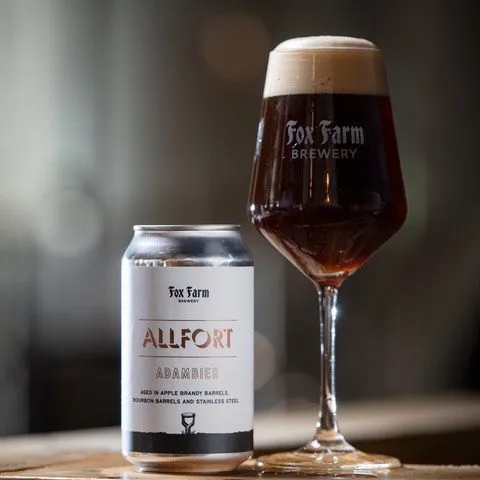
One reason we were drawn to brewing a Burton Ale was that we saw that Invert Sugar (a fundamental component of English brewing) made up roughly 20% of the fermentable sugar source. We found a great source for it, and that motivated us to explore the style. There’s only one manufacturer making smoked wheat, but we wanted something more specific, so we worked with a maltster on our Gorjitski to develop something unique to us. The Adambier used local malt as well.
But the Burton Ale was especially unusual for us in that it’s the first collaboration that wasn’t with another brewery, but with a supplier, and that was born out of our deep respect and admiration for what Thomas Fawcett & Sons means to the brewing world. We love our local New England maltsters; they represent 60 to 70 percent of what we use, but there are certain beers where we’re committed to using malt from the country of origin. Fawcett’s malts are critical components to those beers.
Tell me more about making a Burton Ale.
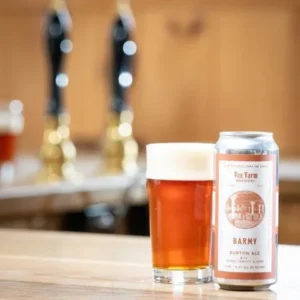
Burton Ale was a popular style for a good 100 years, and in that time it changed quite a bit, especially in and out of the World Wars. That made it a fascinating style to lay all the examples out and decide what we wanted to brew. We blended Maris Otter and Halcyon base malts with their Amber and Dark Crystal. And, true to the period, Invert Sugar No. 2 was used in the boil alongside whole leaf and pellet additions of Fuggle and East Kent Goldings hops. Much of Barmy was packaged in pins and firkins, and we’re proud to see it being poured by some of the greatest proponents of cask ale: at NERAX Cask Festivals in Boston, Brick Store Pub in Decatur, at CBC in Philadelphia, and most recently at Nod Hill Brewery’s Afternoon of Cask Ales.
What has the response been from the community?
We’re small enough that we can make the economics of a single batch work. We’re not making unreasonable volumes. We have wonderful customers who’ve been along for the ride, and that’s something we’re genuinely proud of: we have such a wide range of interests, and our customers are willing to entertain our whims.
Certain categories really deliver consistently: Continental European lagers, farmhouse ales, they’re our foundational pieces. But we’ve been exploring for long enough that our customers almost expect discovery and education from us, and for us, that’s one of the most exciting things about beer. How diverse the world of beer is, the cultural context and significance around it, even the hospitality side: how it’s served, the environment you cultivate. It’s exciting to see.